

If you’re a parent, chances are at some point in your child’s life, you’ll have to deal with head lice!
That’s why it’s extremely important that you know how to identify them.
Head Lice … What Are They?
- Head lice are small grey or reddish-brown bugs (1mm to 4mm).
- Lice live on the human head only – not on pets or other parts of the body.
- Lice cannot survive off the head for more than 24 to 48 hours without a blood meal.
- Lice do not hop, jump or fly.
- Lice eggs are teardrop shaped and glued to one side of the hair shaft on an angle.
- Viable eggs are typically brownish/yellow to caramel in colour – never white.
- Empty egg cases or dead eggs are called, Nits.
- Nits are clear, opaque, almost see through.
- Female lice lay 3 to 5 eggs per day and live for 30 days.
- Lice eggs take 7 to 10 days to hatch and another 7 to 10 days to mature and mate.
- A louse egg is called a Nit; a baby louse is called a Nymph.
How To Find Head Lice?
Mature lice are about the size of a sesame seed. They have six legs and do not have wings. They are usually brownish in colour but this can range from a pale sandy colour to yellowy, grey-brown or dark brown.
Lice eggs are not white. Empty lice eggs may appear to be translucent meaning that they are see-through, and this is why they seem to take on the colour of the hair. If you look at a lice egg (not an adult louse) under the microscope, you can see if the egg is empty or viable. If viable, it will be brown not translucent or opaque.
Nymphs or baby lice are just miniature versions of adult lice and are very hard to see because they are so small. Nymphs can appear red in colour and if you see tiny red dots that seem to move, you could be eye to eye with a baby louse.
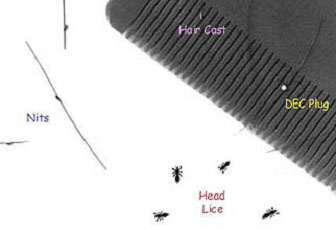
Do not confuse DEC plugs, hair casts or other hair debris with lice eggs. Remember – if it is white, it’s not a lice egg.
Lice eggs are clearly attached to one side of the hair shaft. DEC plugs and hair casts surround the hair shaft. This dandruff like skin debris also sticks to the hair shaft like a nit but they are white and slide easier.
(Note: If you have confirmed head lice you might want to try our one and done #1 Time Head Lice Solution. It works great for lice and nits!)
What tools do I need?
To look for and identify head lice, you will need a bright light – direct sunlight is best and a magnifying visor (glass.) Having a pocket microscope is also a great help; this way, you can pull out a suspicious item, tape it to white paper and have a look with the microscope to make an accurate diagnosis.
Professionals who screen at schools or other locations will use a lighted magnifying visor and will use lice sticks to look through the hair so that the hair can be separated and any debris can be ‘flicked off’. Lice eggs and nits are glued to the hair and will not move when prodded.
How do I find head lice?
Look in the hot spots – around the ears, at the crown of the head and at the nape of the neck. Lice lay their eggs close to the scalp but look along the whole hair shaft.
Separate the hair into sections and begin by checking the crown of the headfirst. Then check the nape of the neck and around the ears. These are popular spots for the initial head lice identification, but lice and their eggs can be anywhere on the human head.
If you find something that you think might be a lice egg or nit, try to remove it with your fingers. If it comes off easily, it’s not likely a lice egg or nit. Lice eggs or nits are cemented on the hair shaft and can only be removed by sliding the nit down the hair shaft between your fingernails or with tweezers
What if I’m not sure?
Before you run to the drugstore for a pesticide consider getting a professional opinion. Your family doctor or health professional may be able to accurately identify head lice or lice eggs. Your local health unit may have a nurse who is experienced in head lice identification and many hairdressers are also good at head lice detection.
Your friends and family might be a great resource as well, especially if they’ve experienced head lice themselves.
A professional service like Lice Squad.com can also help. Specially trained consultants are the experts in identifying head lice and you will be assured of an accurate diagnosis. Some metropolitan areas have clinics where you and your family can be screened for lice.
Still unsure if you’re dealing with head lice? We offer free head lice identification. Please contact us at 1-888-542-3778 for more details or visit our head lice identification page.
(Our #1 Time Head Lice Solution has been a hit with our families. Take the stress out of head lice removal with our one and done system.)
